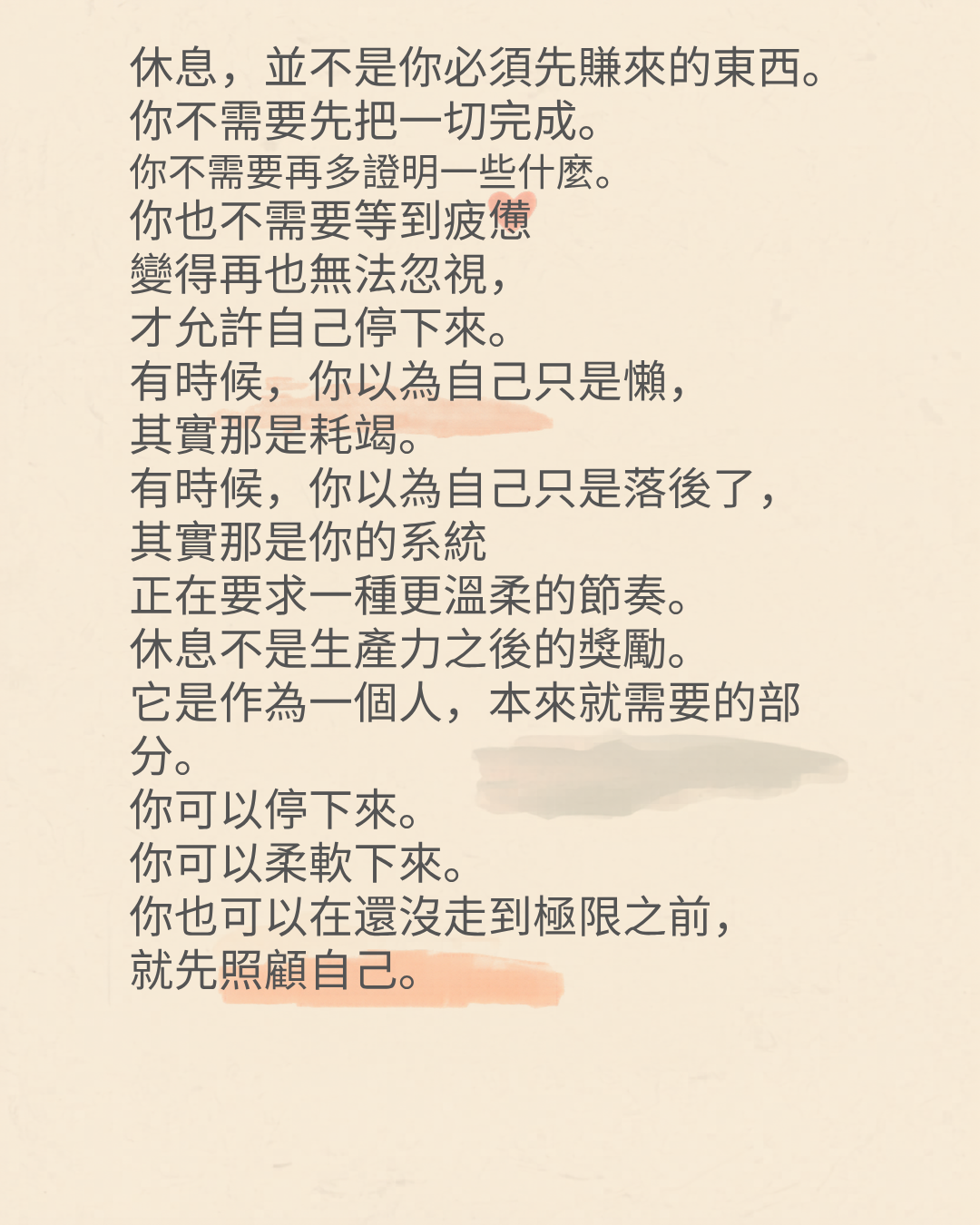
There are times in life
when rest begins to feel like something
you have to justify.
Something you need to earn.
Something you are only allowed to receive
after you have finished enough,
proven enough,
given enough,
or carried enough.
Until then,
you keep going.
You tell yourself
you will slow down later.
You will breathe later.
You will take care of yourself later.
You will pause
once everything is done.
But for many people,
everything is never fully done.
There is always one more task.
One more message.
One more responsibility.
One more thing to think about.
One more version of yourself
you feel pressured to maintain.
And so rest keeps getting postponed,
not because you do not need it,
but because somewhere along the way,
you learned to associate rest
with permission.
Not a natural rhythm.
Not a form of care.
Not something built into life.
But permission.
Permission that must be deserved.
This is one of the quieter distortions
many people carry.
The belief that your worth
is measured by how much you can hold.
How productive you are.
How efficient you are.
How available you are.
How well you keep functioning
even when you are tired.
How gracefully you continue
even when something inside you
is asking for a break.
And because this pattern
is so deeply normalized,
it can become difficult
to recognize exhaustion
until your body begins to speak more loudly.
Through tension.
Through irritability.
Through numbness.
Through difficulty focusing.
Through emotional heaviness
that seems to come from nowhere.
Through a kind of inner disconnection
that makes even simple things feel harder than they should.
Sometimes what you call lack of motivation
is actually depletion.
Sometimes what you call laziness
is actually exhaustion.
Sometimes what you call falling behind
is actually your nervous system
asking for a different pace.
But in a culture
that praises constant output,
rest can feel uncomfortable.
Not because it is wrong,
but because it interrupts
the identity of being the one
who always manages,
always shows up,
always keeps going.
Rest asks something different of you.
It asks you
to stop measuring your value
through performance.
It asks you
to trust that you do not need
to be at your limit
before you are allowed to soften.
It asks you
to remember that being human
was never meant to feel
like a never-ending act of proving.
Real rest
is not only physical.
It is emotional.
Mental.
Energetic.
It is the exhale
you have been postponing.
It is the unclenching
you did not realize you were holding.
It is the moment
you stop demanding so much from yourself
just to feel acceptable.
And perhaps that is why
rest can feel strangely vulnerable.
Because when you slow down,
you often meet
what the busyness was helping you avoid.
The grief.
The uncertainty.
The overstimulation.
The disappointment.
The emptiness.
The truth
that you have been running on more effort
than nourishment.
Rest does not always feel peaceful at first.
Sometimes it feels unfamiliar.
Sometimes it reveals
how long you have been overriding yourself.
Sometimes it brings you face to face
with how much you have normalized living
in a state of tension.
But that does not mean
rest is not right for you.
It may simply mean
your system is learning
how to feel safe
without being in constant motion.
There is a difference
between giving up
and letting yourself recover.
There is a difference
between becoming passive
and choosing to replenish.
There is a difference
between avoidance
and allowing space.
Rest is not the opposite of growth.
Often,
it is what makes growth sustainable.
Because a life built only on pushing
will eventually ask too much of you.
A life built only on performance
will slowly disconnect you
from your own needs.
A life built without rest
may look functional from the outside,
while feeling brittle from within.
You were not meant
to live every day
as if your body were a machine
and your inner world had no limits.
You were not meant
to only soften
after breaking.
You were not meant
to collapse
before you listen.
You are allowed
to rest before you are completely depleted.
You are allowed
to pause before you reach burnout.
You are allowed
to choose a gentler pace
even if the world around you
keeps rushing.
You are allowed
to stop treating care
like a reward.
Rest is not a prize
for being productive enough.
It is not proof
that you have finally done enough
to deserve your own kindness.
It is not a luxury
reserved only for those
who have no responsibilities.
It is part of balance.
Part of healing.
Part of clarity.
Part of living in a way
that does not constantly abandon yourself.
And maybe this is the deeper invitation:
To stop asking,
“Have I done enough to rest?”
And begin asking,
“What would it look like
to treat rest as a form of respect?”
Respect for your body.
Respect for your energy.
Respect for your emotions.
Respect for the life within you
that was never meant
to be driven without tenderness.
You do not need
to wait until everything is finished.
You do not need
to collapse in order to justify care.
You do not need
to earn softness
through exhaustion.
You are already allowed to rest.
Not later.
Not once you have proven more.
Not after you have reached a breaking point.
Now.
Perhaps real healing begins
the moment you stop negotiating
with your own need for care.
The moment you stop making rest
conditional.
The moment you remember
that a more whole life
is not built only through discipline and effort,
but also through gentleness,
through recovery,
through enoughness,
and through the courage
to slow down
before your soul is forced to ask more loudly.
Rest is not something
you have to earn.
It may be one of the most honest ways
to remain in relationship
with yourself.

Leave a Reply