
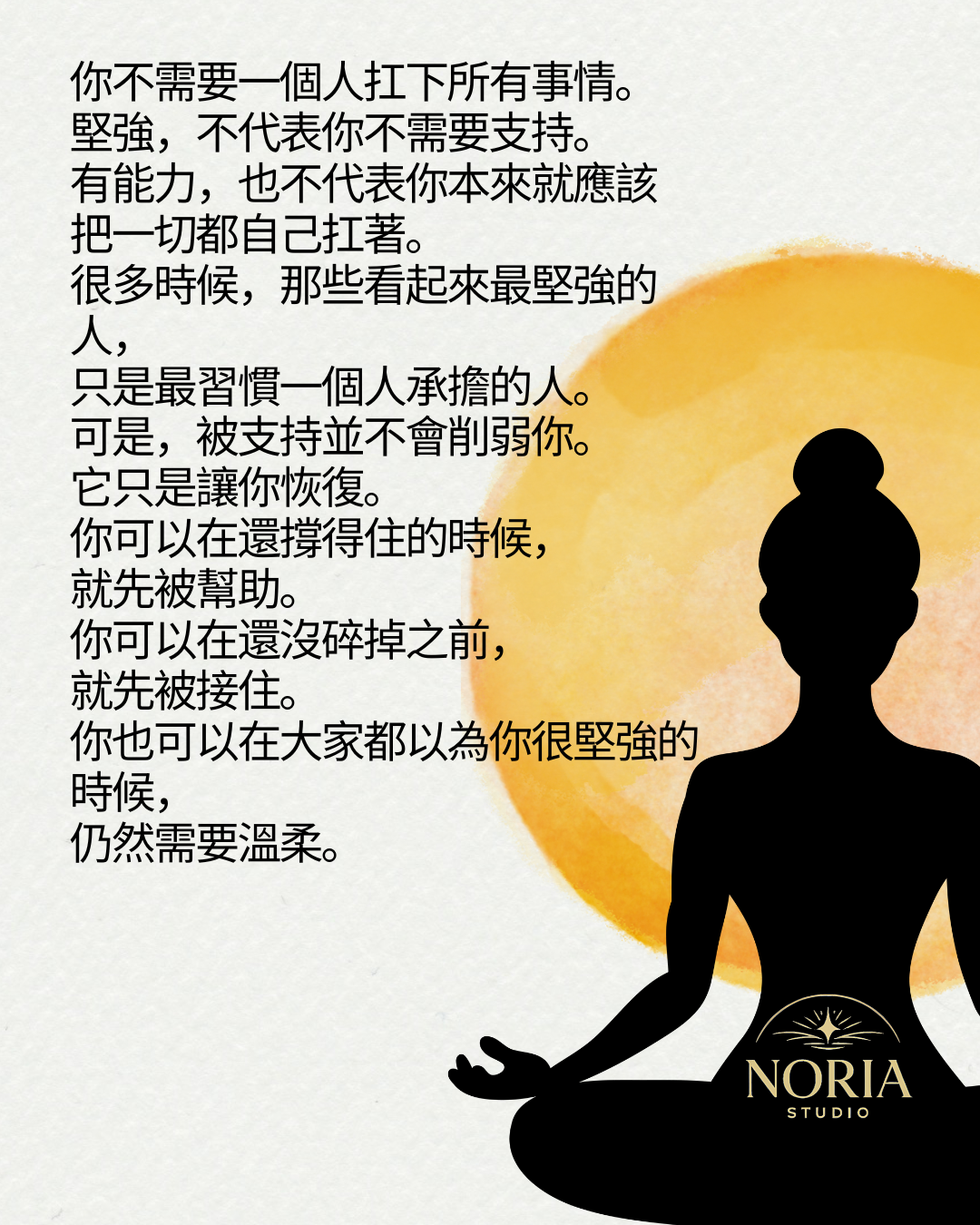
There are many people
who have become so used to being strong
that they no longer notice
how much they are carrying.
They keep going.
They keep managing.
They keep responding, solving, holding, organizing, enduring.
From the outside,
they often look capable.
Reliable.
Composed.
Resilient.
They are the ones
who know how to keep things moving.
Who know how to stay functional.
Who know how to make it through.
And because they have learned
how to hold so much,
people often assume
they do not need much in return.
That they are fine.
That they can handle it.
That they will ask if they need something.
But sometimes
the people who seem the strongest
have simply become the most practiced
at carrying things alone.
They are not always okay.
They are not always rested.
They are not always supported
in the ways they deserve.
They have just learned
how to keep going
without making their need visible.
For many people,
this pattern begins early.
You learn how to adapt.
How to not be too much.
How to not ask for too much.
How to stay useful.
How to stay composed.
How to survive by being capable.
And over time,
competence can become
more than a skill.
It can become an identity.
The dependable one.
The calm one.
The one who does not fall apart.
The one who keeps helping others.
The one who does not need much.
The one who can hold it all.
At first,
this identity may feel protective.
It may help you feel safe.
Respected.
Needed.
Valuable.
But eventually,
it can become heavy.
Because there is a difference
between being strong
and never allowing yourself
to be supported.
There is a difference
between resilience
and chronic self-abandonment.
There is a difference
between being capable
and feeling like you must carry everything
by yourself
in order to be worthy.
Sometimes the hardest thing
for a strong person to admit
is not that life feels hard.
It is that they want support.
Not advice.
Not praise for how well they are handling it.
Not more evidence
that they are impressive under pressure.
Support.
Real support.
The kind that softens your body.
The kind that lets your nervous system exhale.
The kind that reminds you
you do not always have to be
the one holding everything together.
This can feel strangely uncomfortable
if you are used to being the one
others lean on.
Because receiving
requires a different kind of openness.
It asks you
to stop performing strength
for a moment.
It asks you
to let someone see
what is not polished.
What is tired.
What is uncertain.
What needs care.
And for people
who have learned to survive
through self-sufficiency,
that can feel deeply vulnerable.
Sometimes receiving support
feels harder
than carrying the weight alone.
Because carrying it alone
is familiar.
It gives you control.
It gives you identity.
It keeps you in the role
you know how to perform.
Receiving, on the other hand,
asks for trust.
Trust that your needs
will not make you too much.
Trust that needing help
does not make you weak.
Trust that being supported
does not erase your strength.
Trust that you are still worthy
even when you are not the one
holding everyone else.
This is not always easy.
Especially if your life
has taught you
that asking for support
leads to disappointment.
Or misunderstanding.
Or silence.
Or the feeling
that your needs are inconvenient.
In that kind of inner history,
self-reliance can feel safer
than hope.
It can feel cleaner.
More predictable.
More dignified.
But safe
and nourishing
are not always the same thing.
A life built only on self-protection
can become very lonely.
A life built only on holding yourself together
can become quietly exhausting.
And a life in which you are always the one giving
can slowly distance you
from your own softness.
The truth is,
being human was never meant
to be a completely solitary act.
We are not designed
to carry every grief alone.
Every responsibility alone.
Every uncertainty alone.
Every transition alone.
Support is not a failure
of independence.
It is part of being alive.
It is part of what helps us
stay connected
to ourselves
and to each other.
There is no special prize
for making everything harder
than it needs to be.
There is no deeper worth
in always being the one
who never asks,
never needs,
never leans,
never lets anyone in.
Sometimes strength
is not found
in tightening your grip.
Sometimes it is found
in loosening it.
In saying,
“I do not want to carry this alone.”
In admitting,
“This is heavy.”
In letting care reach you
before you are completely depleted.
In allowing yourself
to be met,
instead of only admired.
Because being admired
for your strength
is not the same
as being supported
in your humanity.
One makes you impressive.
The other makes you safe.
And often,
what the heart really needs
is not more admiration.
It is more safety.
More room to soften.
More room to tell the truth.
More room to not know.
More room to be imperfect
without losing love.
You do not need
to collapse
before you are allowed
to ask for support.
You do not need
to prove
that you have done everything possible
on your own first.
You do not need
to be at the end of yourself
before care becomes justified.
You are allowed
to be helped
while you are still functioning.
You are allowed
to be held
before you break.
You are allowed
to need tenderness
even if everyone else
has come to know you
as the strong one.
Maybe one of the quietest forms of healing
is learning that support
does not diminish you.
It restores you.
It reminds you
that your worth
was never dependent
on how much you could carry
without asking for anything back.
It reminds you
that being loved
is not the same thing
as being useful.
It reminds you
that your humanity
does not become inconvenient
just because it has needs.
And maybe that is the deeper invitation here:
To stop treating support
like something you only deserve
when you are no longer able to cope.
To stop assuming
that strength means silence.
To stop equating worth
with how gracefully
you can suffer alone.
You do not have to carry everything alone.
Not to be respected.
Not to be enough.
Not to be strong.
Not to be loved.
Sometimes the most honest thing
you can do
is let yourself be supported.
Let yourself be seen.
Let yourself be cared for.
Let yourself be human.
Because perhaps
real strength
is not only in what you can hold.
Perhaps it is also
in what you are finally willing
to stop holding alone.

Leave a Reply