
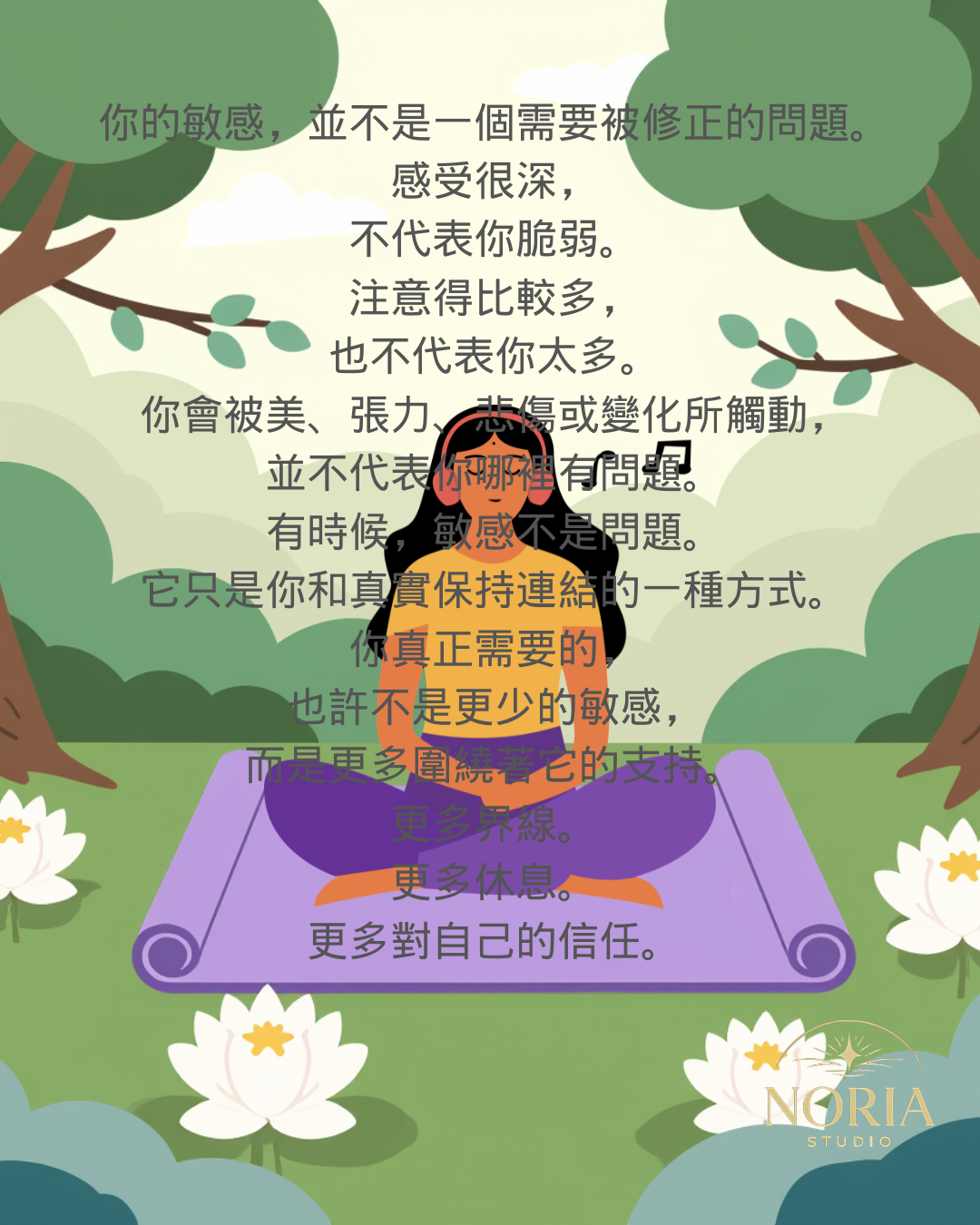
There are many people
who have spent a large part of their lives
trying to become less sensitive.
Less affected.
Less emotional.
Less easily overwhelmed.
Less moved by tone, energy, tension, beauty, sadness, disappointment, or change.
Somewhere along the way,
they began to believe
that sensitivity was the problem.
That feeling deeply
made life harder than it needed to be.
That noticing too much,
caring too much,
absorbing too much,
or being affected too easily
meant something in them
was too fragile.
So they tried to manage it.
They tried to become tougher.
More detached.
More composed.
Less reactive.
Less soft.
And in some ways,
this makes sense.
Because if your sensitivity
has often been met
with misunderstanding,
dismissal,
or pressure to “not take things so personally,”
you may have learned
to treat that part of yourself
as inconvenient.
Something to hide.
Something to outgrow.
Something to control
before it makes you seem too much.
But sensitivity
is not always excess.
It is not always weakness.
It is not always something
that needs to be corrected
in order for you to belong in the world.
Sometimes,
sensitivity is the way
you remain in contact
with what is true.
It is the way
you notice what others miss.
The shift in a room.
The sadness under someone’s smile.
The beauty in something small.
The exhaustion behind your own performance.
The tension in your body
before your mind has found words for it.
Sensitivity can make you
more aware.
More attuned.
More perceptive.
More responsive
to what is happening
beneath the surface.
And while that awareness
can at times feel heavy,
it can also be deeply meaningful.
Because a person
who feels deeply
is often a person
who is still connected.
Connected to nuance.
Connected to beauty.
Connected to pain.
Connected to humanity.
Connected to the subtle truths
that a more defended life
might stop noticing.
This does not mean
sensitivity is always easy.
Of course it is not.
There are seasons
when feeling everything so vividly
can be exhausting.
When the noise feels too loud.
When the tension feels too sharp.
When the emotions of others
seem to reach you too quickly.
When your own inner world
feels crowded
by everything you are trying to process.
In those moments,
it is understandable
to want relief.
To want distance.
To want thicker skin.
To want a way
to move through life
without being touched so easily.
But there is a difference
between learning how to care for your sensitivity
and trying to erase it.
One is self-respect.
The other is self-rejection.
One says,
“I need boundaries, rest, rhythm, and discernment
so I can stay connected to myself.”
The other says,
“I need to become less like I am
in order to be acceptable.”
These are not the same.
Sensitivity does not ask you
to be flooded by everything.
It does not ask you
to absorb every emotion,
carry every atmosphere,
or remain unprotected
in environments that keep overwhelming you.
Sensitivity still needs skill.
It needs boundaries.
It needs language.
It needs space.
It needs nervous system care.
It needs environments
that do not constantly punish softness.
It needs the wisdom
to know the difference
between being open
and being porous.
Between being compassionate
and overextending.
Between feeling deeply
and abandoning yourself
in the emotions of everyone else.
This is where maturity enters.
Not in becoming harder,
but in becoming more grounded
inside your own tenderness.
Learning how to stay soft
without becoming undone.
Learning how to feel deeply
without losing your center.
Learning how to honor what affects you
without assuming
that being affected means something is wrong.
Because perhaps
the goal was never
to become less sensitive.
Perhaps the invitation
is to become more supported
inside your sensitivity.
More discerning.
More rested.
More honest
about what drains you.
More intentional
about what you let close.
More willing
to protect the part of you
that feels deeply
instead of constantly shaming it.
There is also grief
in realizing
how much time you may have spent
trying to harden yourself
into someone
you were never meant to be.
Trying to become easier.
Less intense.
Less impacted.
Less tender.
Trying to perform resilience
in ways that slowly disconnected you
from your own inner truth.
And maybe that is why
coming back to your sensitivity
can feel so emotional.
Because it is not only
about accepting how you are.
It is also about mourning
how often you were taught
to turn away
from your own natural way of being.
Maybe no one taught you
that sensitivity could be sacred.
Maybe no one showed you
that emotional depth
could be guided
rather than suppressed.
Maybe no one reminded you
that tenderness
does not make you weak.
It makes you alive.
It makes you reachable.
It makes you human.
It makes beauty matter.
It makes connection matter.
It makes dishonesty harder to tolerate.
It makes depth feel necessary.
It makes you notice
when something is off
before the world has language for it.
Sensitivity is not the same
as instability.
And protecting your tenderness
is not the same
as withdrawing from life.
Sometimes the most deeply rooted people
are not the ones
who feel the least.
They are the ones
who have learned
how to feel fully
without becoming ashamed
of their own hearts.
How to stay open
without staying exposed.
How to soften
without collapsing.
How to let life touch them
without letting every experience
define them.
That kind of sensitivity
is not a liability.
It is a form of intelligence.
A quiet intelligence.
An embodied intelligence.
A relational intelligence.
A spiritual intelligence.
It tells you
when something is off.
When something is beautiful.
When something is too much.
When something is true.
When something deserves your presence.
When something requires distance.
And perhaps
this is the deeper shift:
To stop asking,
“How do I become less sensitive?”
And begin asking,
“How do I care for my sensitivity
so it can remain a gift
instead of becoming a burden?”
How do I protect my energy
without closing my heart?
How do I stay honest
without becoming overwhelmed?
How do I build a life
that is gentle enough
for the person I actually am?
You do not need
to become harder
in order to be respected.
You do not need
to feel less
in order to be mature.
You do not need
to silence your tenderness
in order to move through the world well.
What you may need
is not less sensitivity.
But more support around it.
More self-trust.
More boundaries.
More recovery.
More truth.
More permission
to stop treating your emotional depth
as a flaw.
Your sensitivity
is not something you need to fix.
It may be one of the ways
your life keeps leading you
back toward what is real.

Leave a Reply